
Why Sitting Worsens Low Back Pain: It's Not Just Your Spinal Muscles
When your lower back feels heavy and stiff, it's natural to rub the sore spot or arch backward to stretch it out. It may feel better for a moment right after stretching, but after just an hour or two at your desk, your back stiffens up all over again.
Hello, I'm Dr. Ahn Jae-seok, director of Seoul Cheongdam Dr. Anapa Clinic, where I treat pain patients in Dasan New Town, Namyangju. When your lower back feels heavy and stiff, it's natural to rub the sore spot or arch backward to stretch it out. It may feel better for a moment right after stretching, but chances are you've noticed that after just an hour or two at your desk, your back stiffens up all over again.
When I see patients with low back pain, I don't just press on the area that hurts. I always ask, "How many hours a day do you sit, and in what posture?" and "When and how do you use your back during the day?"
That's because treatment in the clinic matters, but if we don't also look at the load your back accumulates in daily life after you walk out the door, the pain eventually comes right back.
■ Your Spinal Erector Muscles Don't Work Alone
When the lower back feels tight, people often say their "erector spinae muscles are knotted up." The erector spinae is a long group of muscles running along both sides of the spine from the neck down to the pelvis. It is the core pillar that keeps your spine upright and stabilizes you when you lean or twist your torso.
But the erector spinae never carries the weight of the spine by itself. Your back stays comfortable only when the abdominal muscles (rectus abdominis and transversus abdominis) in front, and the gluteal muscles along with the ligaments and joints around the pelvis below, all work together as a team.
When you sit in one fixed position for a long time, the abdominal and gluteal muscles tend to switch off and slacken. As a result, the erector spinae ends up shouldering an excessive load on its own to keep the spine from collapsing, becoming stiff and locked in a protective state of tension.
■ A Case from the Clinic: "I Sat Up Perfectly Straight. Why Does It Hurt More?"
This is the story of Patient A, an office worker in their late 30s who recently visited us from Dasan-dong. Here was their concern: "My back kept feeling stiff, so after watching some YouTube videos I started sitting bolt upright and kept my stomach and back muscles tensed while I worked. But a few days later my back became stiff with stabbing pain, and on the way home from work it was hard even to walk." Patient A was a classic case of falling into a different trap while trying to avoid slouching. In their effort to sit up straight, they had been holding their spine overly arched (hyperextended) and keeping their abdominal and erector muscles tensed all day long.
After first examining them to check for any nerve compression, we provided pain treatment to relieve the burden on their overworked erector muscles and re-taught them how to sit in a chair. Once they stopped bracing and holding themselves rigid, and let their hips and the chair back share their body weight, the pain that had lasted for weeks eased noticeably.
"A hard, knotted muscle isn't necessarily the root of the problem." Tight muscles don't automatically mean a herniated disc. Conversely, even if an X-ray or MRI shows a degenerative disc, that doesn't mean the pain you feel now comes solely from that degeneration. The true cause becomes clear only after a comprehensive examination of when the pain starts, whether it radiates down the leg, and how it changes with movement.
■ A 3-Step Setup for People Who Work Sitting Down
The real goal of posture correction isn't to lock your body into "one correct shape" like a soldier at attention. It's to give your joints and ligaments enough room to share the load comfortably.
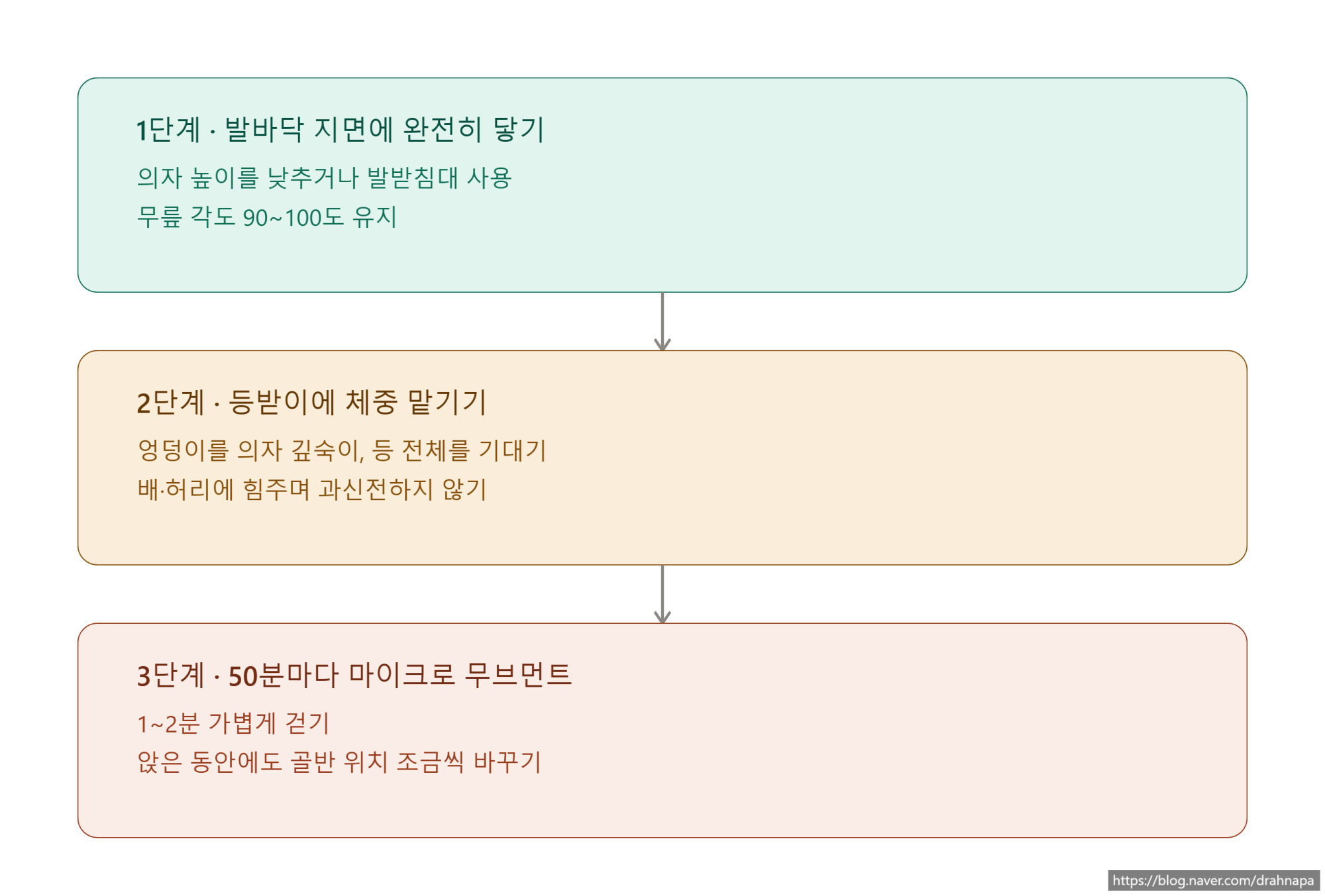
- Make sure your feet rest flat on the floor
If your chair is so high that your heels lift off the floor, your body weight shifts onto your lower back and the backs of your thighs. Lower the chair so the soles of your feet rest fully on the floor, and if your desk is too high to allow that, be sure to use a footrest to keep your knees at a 90–100 degree angle.
- Let the backrest take your weight, but avoid overarching
Tensing your stomach and back to sit bolt upright makes your erector muscles tire quickly. Slide your hips all the way back in the seat, lean your whole back comfortably against the backrest, and let the chair take some of your body weight.
- Practice "micro-movements" every 50 minutes
Even the most perfect posture in the world becomes harmful to your spine if you hold it for more than an hour. Before the pain kicks in, get up every 50 minutes and walk around lightly for 1–2 minutes, and while seated, shift the position of your pelvis little by little to spread out the load.
■ A 1-Minute Chair Relaxation Routine We Recommend
When your back feels stiff at work, don't force it by twisting or bending it hard. Instead, try these movements that safely release tension in the stiff erector muscles and pelvis. Pelvic Tilt on Chair
-
Sit upright in your chair and place your hands on your hip bones.
-
As you breathe out, gently round your back and tilt your pelvis backward as if your tailbone were touching the seat. (You'll feel your lower back muscles gently lengthen.)
-
As you breathe in, bring your pelvis back upright as if lifting your tailbone slightly. Move only to your spine's natural curve without overarching your lower back.
-
Repeat slowly 10 times, in rhythm with your breathing.
Seated Glute Stretch
-
Place one ankle on the opposite knee so your legs form a "4" shape.
-
Keeping your spine straight so your lower back doesn't round, gently lean your upper body forward from the hip joint (pelvis).
-
Hold for 15–20 seconds at the point where you feel a gentle pull along the outside of your hip. (3 times on each side)
■ See a Doctor Right Away If You Have These Symptoms
Simple muscle overtension or postural imbalance often improves with changes to your environment and nonsurgical pain treatment. However, if you have any of the following warning signs of nerve compression (red flags), don't try to tough it out with posture exercises. Seek prompt medical evaluation for an accurate diagnosis.
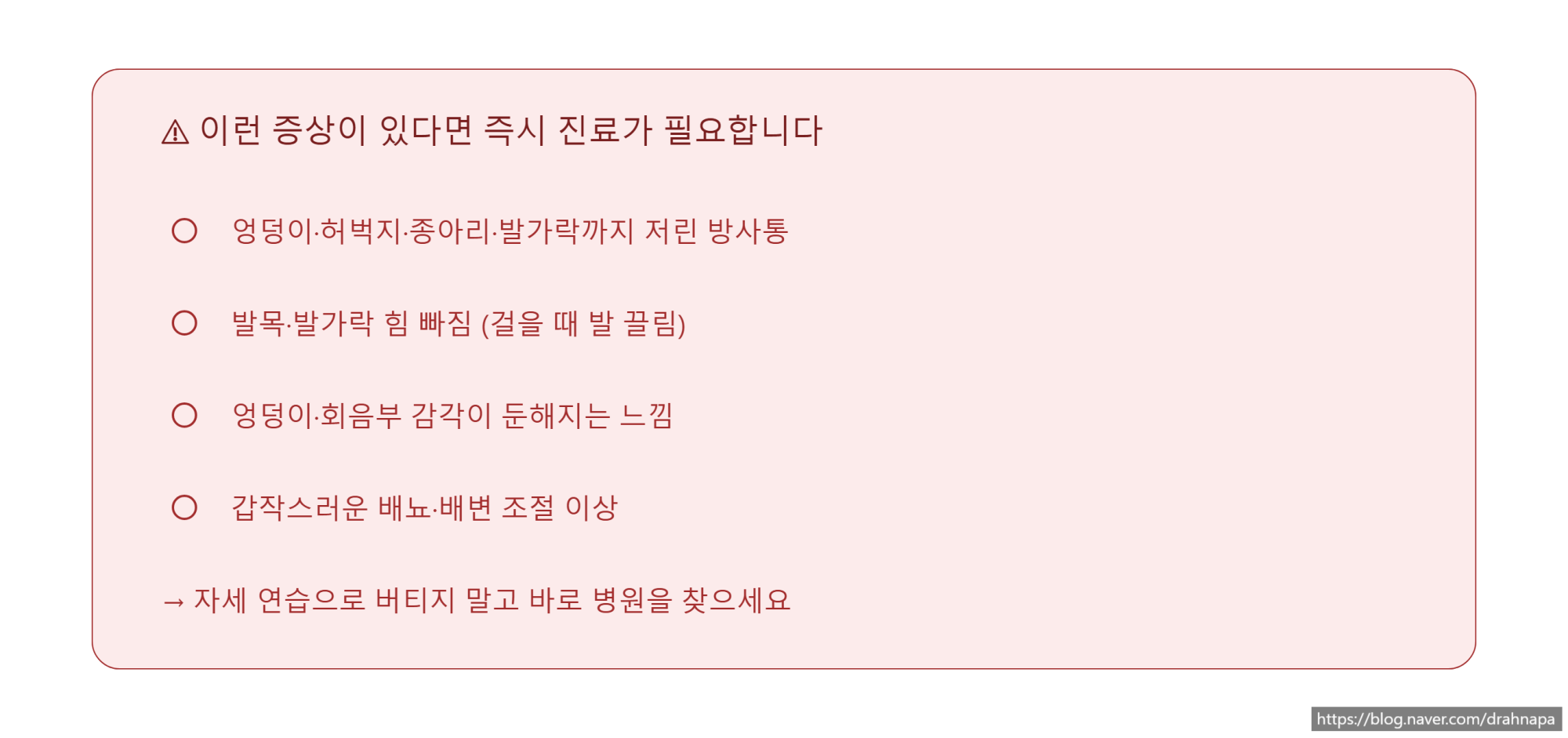
・ Numbness, tingling, or shooting pain that radiates past the buttock into the thigh, calf, or toes ・ Weakness in the ankle or toes that makes you drag your foot when walking or lose your slippers ・ Reduced sensation around the buttocks or groin (perineum) ・ Sudden loss of control over urination or bowel movements Pain is your body's alarm telling you that "the way you're using it right now is overloading it."
At Seoul Cheongdam Dr. Anapa Clinic, we don't stop at simply calming the symptoms where it hurts. We carefully review your imaging results along with your actual joint mobility and your everyday posture and loading habits to offer a personalized, one-on-one care plan.
If chronic low back pain is getting in the way of your daily life, don't just put up with it on your own. Come in for a thorough, systematic examination.
This post provides medical information from Seoul Cheongdam Dr. Anapa Clinic. The appropriate diagnosis and treatment may vary depending on each person's condition and spinal structure.
About the Author
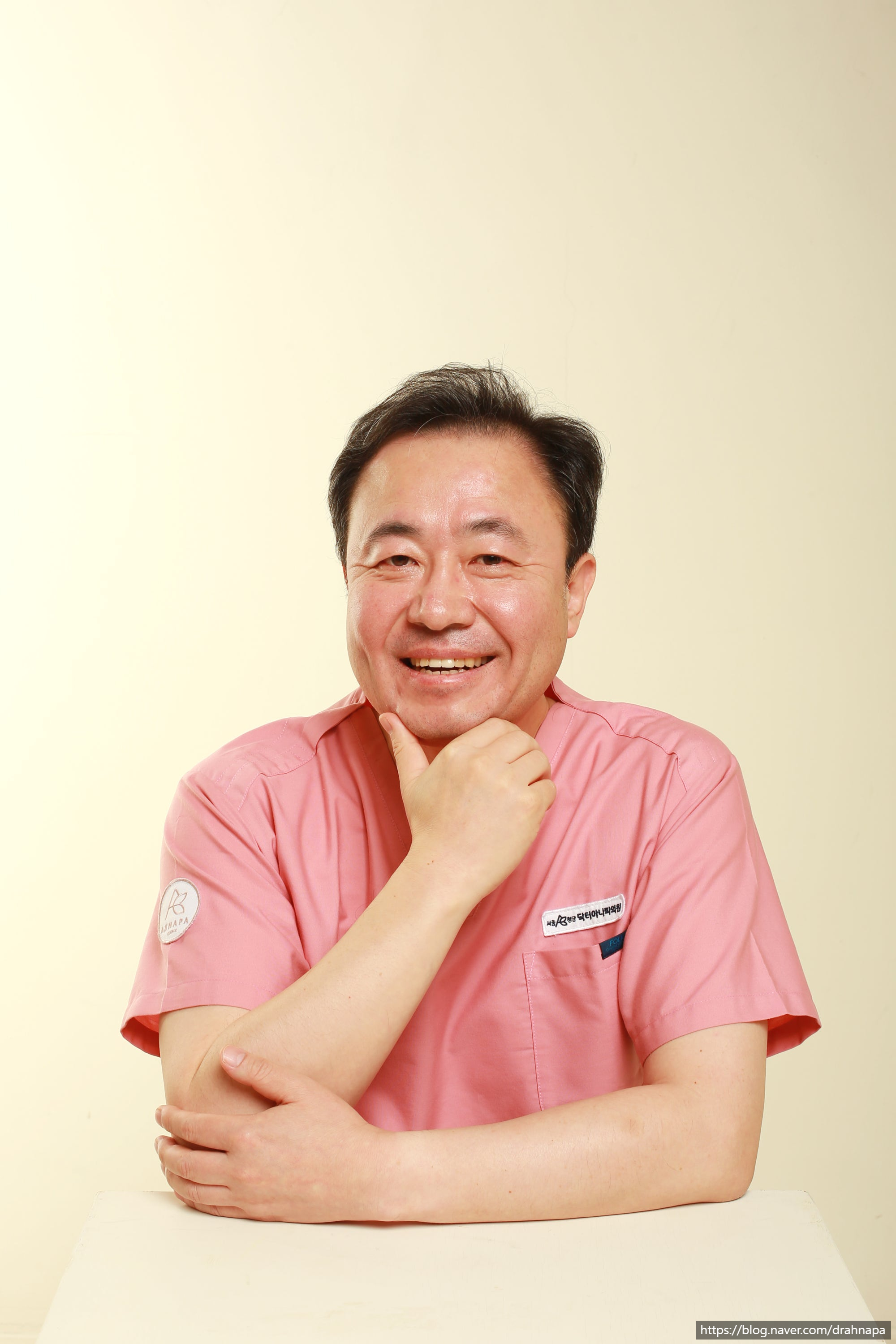
Dr. Ahn Jae-seok, board-certified in anesthesiology and pain medicine, Director of Seoul Cheongdam Dr. Anapa Clinic. Seoul Cheongdam Dr. Anapa Clinic is an anesthesiology and pain medicine clinic in Dasan New Town, Namyangju, offering chronic pain treatment alongside nonsurgical anti-aging medicine that helps you look younger without surgery. Drawing on extensive clinical experience, the clinic specializes in nonsurgical anti-aging treatments including fat grafting, thread and laser lifting, and adipose-derived stem cell therapy.
Seoul Cheongdam Dr. Anapa Clinic | Nonsurgical Rejuvenation Tailored to Your Face
When it hurts, Dr. Anapa
Face or pain, we start by finding out why. Book by phone or online.