
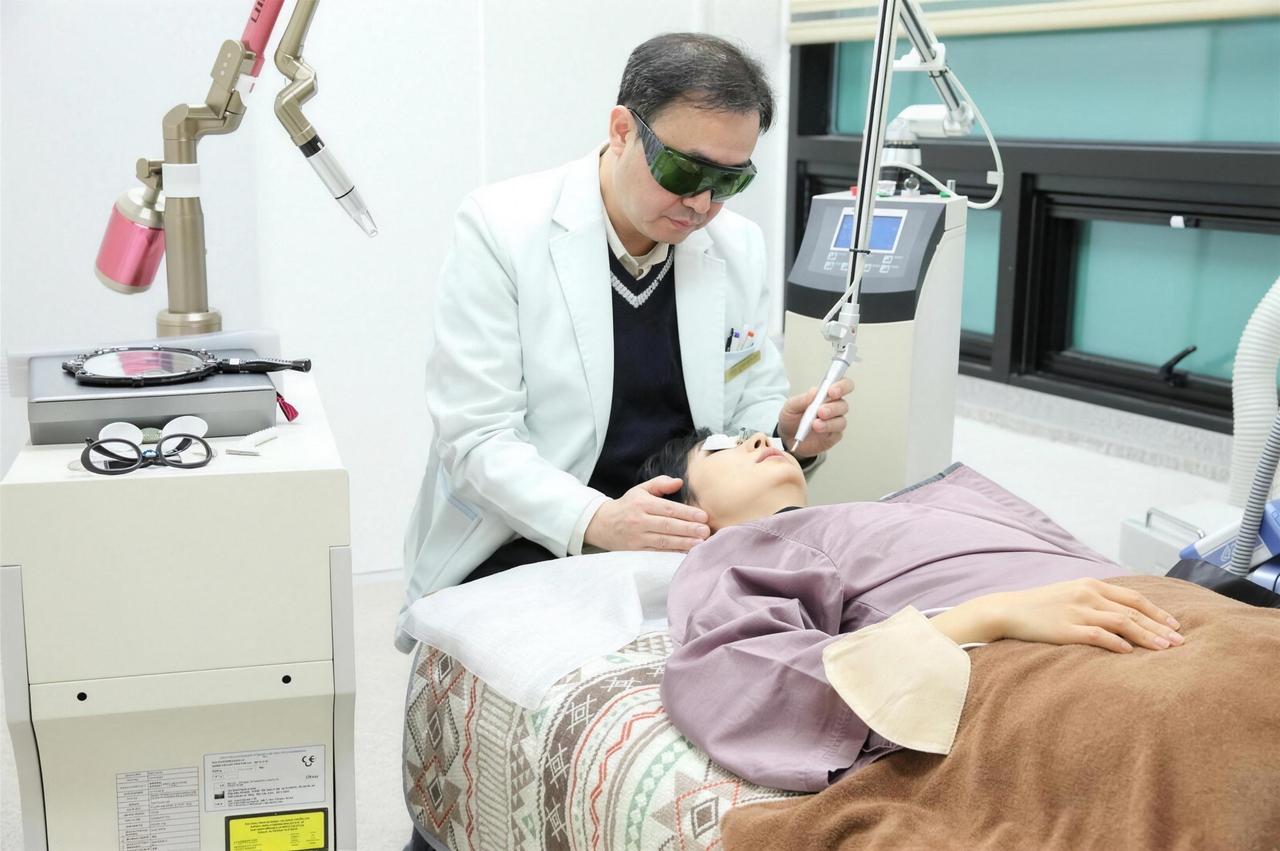
Flat wart removal
Flat warts: begin with diagnosis
At a glance
Flat warts, the short version.
Cause
HPV types 3 and 10
Lesion
Flat papules, 1-5 mm
Treatment
CO2 and Er:YAG laser
Process
Cleared in stages, not all at once
Flat warts are a viral skin condition caused by HPV types 3 and 10. They appear as flat papules of 1-5 mm, clustered or arranged in a line, and are usually neither itchy nor painful.
Why they seem to appear all at once
Three things overlap. Scratching or squeezing carries the virus to the skin beside it. When overwork and poor sleep lower immunity, a dormant virus becomes active again. And the incubation period runs from weeks to years, so lesions infected long ago only become visible later.
Easily confused with milia and skin tags
Flat warts are hard to tell from milia, skin tags and closed comedones by eye. Squeezing or picking spreads them, so the first step is confirming that the lesion is HPV.
Considering flat wart removal
Identify the lesion and review its condition before discussing removal and skin care.

Addressing the route of spread
We start with the habits that cause self-inoculation, so the lesions stop spreading sideways.

Confirming the type of lesion first
Telling flat warts from milia and skin tags avoids treating the wrong thing.

Treating in stages
Rather than clearing everything in one session, we remove in stages and watch the response.
How the visit proceeds
Identify the lesion, review its distribution and daily irritation, then discuss removal and aftercare.
- 1
Differential diagnosis
We separate flat warts from milia, skin tags and closed comedones and confirm the lesion is HPV.
- 2
Assessing lesions and sources of irritation
We assess the number and spread, whether they line up, immune status, and daily irritation such as shaving or scrubs.
- 3
Removal in stages
Lesions are removed with a CO2 or Er:YAG laser; the number of sessions and the interval are agreed in consultation.
- 4
Managing recurrence
There is still no way to clear dormant virus entirely, so we manage immunity and irritation to reduce new lesions.
Is this actually a flat wart?
A photograph is rarely enough. We look at the lesion in the room and tell you what it is first.
When small bumps spread
Identify bumps on the forehead or cheeks before discussing removal.

People with clusters of small bumps on the forehead or cheeks
Often mistaken for acne and squeezed, after which they multiply.

People whose bumps spread after picking
Lesions in a line can be the trace of self-inoculation.

People whose bumps persist after acne care
If the lesion is something else, the treatment has to be something else too.
FAQ
How are flat warts distinguished from milia?
Not reliably by eye. In the room we look at shape, arrangement and history to confirm it is HPV.
Can flat warts be removed all at once?
Not always in one session. Dormant virus can surface as new lesions later, so we work in stages.
Do flat warts come back?
There is no way yet to clear dormant HPV from the skin, so new lesions can appear depending on immunity and irritation.
What happens to flat warts when immunity is low?
When overwork or lack of sleep lowers immunity, dormant virus can become active again and lesions may increase. Your immune status is reviewed at consultation.
Aftercare guidance
Four things that keep them from spreading.
Do not pick or squeeze the area
Scratching or squeezing carries the virus to the skin next to it.
Avoid razors and scrubs on the area
Friction around the lesion becomes the route the virus travels.
Sun protection
Treated skin pigments easily, so use sunscreen carefully.
Get enough sleep and avoid overexertion
When immunity drops, dormant virus becomes active again.
When it hurts, Dr. Anapa
Face or pain, we start by finding out why. Book by phone or online.